City Faces Lawsuit Over Sidewalk Fall
RAYMOND, Wash. – A recently filed lawsuit in the Pacific County Superior Court is shining a spotlight on the legal responsibilities surrounding maintenance of public sidewalks, municipal duty, and adjacent property ownership.
The lawsuit filed in the court by Hagen & Bates P.S. on Sept. 1 stems from a trip-and-fall that occurred on Oct. 11, 2023, in downtown Raymond.
The Allegations
According to the court filing, a Raymond resident – acting individually and as the personal representative of the Estate of… (who died June 28) – experienced the incident on an uneven and raised section of a public sidewalk located adjacent to a property on Duryea Street in Raymond.
“On or about Oct. 11, 2023, Plaintiff…tripped and fell on an uneven and raised section of sidewalk adjacent to 209 Duryea St,” the lawsuit states. “As a result, she sustained serious injuries and damages, including pain, disability, and medical expenses.”
“The City either created the defect or had actual or constructive notice of it and failed to correct or warn of the condition,” the lawsuit adds.
The property adjacent to where the fall occurred belongs to…who are named under claims of common-law premises liability and negligence. The lawsuit states that the adjacent property owners “owed a duty not to create or permit dangerous conditions on or adjacent to the sidewalk.”
“The [adjacent property owners] negligently failed to inspect, repair, maintain, or warn of the hazardous sidewalk condition,” the lawsuit states.
The foundation of the lawsuit points to Raymond Municipal Code Section 12.36.010, which imposes a duty on owners or occupants of abutting lots to keep bordering sidewalks in good repair and free from obstructions.
The lawsuit also incorporates a survival claim for pre-death loss of consortium on behalf of the estate of the late…, pursuant to RCW 4.20.046.
Defense Responses and Assertions
As the case moves through the judicial process, the defendants have formally responded by denying liability.
In an answer filed Sept. 30, the City contested the legal conclusions of the complaint and raised several standard affirmative defenses. These defenses include arguments regarding comparative fault, discretionary immunity protecting the reasonable exercise of public official judgment, assumption of risk, and failure by plaintiff to mitigate damages.
Regarding the facts presented by the lawsuit paragraphs 3.1–3.4, the City states, “Defendant is without knowledge sufficient to form a belief as to the truth of the allegations contained in this paragraph, and therefore, denies the same,” the city’s defense response states.
As for paragraphs 3.5–3.9, the City states, “This paragraph does not contain allegations directed at the Defendant and thus does not warrant answering; to the extent an answer is warranted, this paragraph is denied,” and for paragraph 3.10, the City states, “Defendant denies the allegations in this paragraph as containing legal conclusions.”
The response further prays that “Plaintiff’s complaint be dismissed with prejudice and that Plaintiff takes nothing by her complaint.”
Status
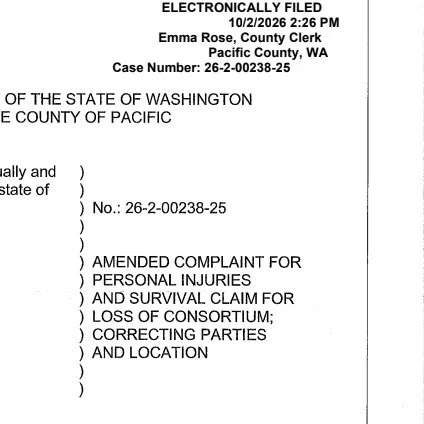
The case underwent initial administrative corrections regarding the exact property location and involved corporate entities before an amended complaint was officially authorized and filed via an agreed order on Oct. 2.
The court has waived certain statutory notice timelines by agreement of the parties to streamline the proceedings, and a jury trial has been formally demanded. As the litigation moves forward, no determinations of liability have been made by the court, and all parties maintain their right to present evidence and defenses at trial.
The lawsuit lays out four claims for relief: negligence by the City, negligence by the adjacent property owners, premises liability by the adjacent property owners, and a surviving claim for loss of consortium.
“Plaintiff…, individually, has sustained past and future medical expenses, pain and suffering, loss of enjoyment of life, and lost wages,” the lawsuit states.
The lawsuit later specifies in a prayer for relief: “Wherefore, Plaintiffs pray for judgment against Defendants, as their respective liability may be established, as follows: 1. For general and special damages sustained by…individually, and for the pre-death loss-of-consortium damages surviving to the Estate of…, in amounts to be proven at trial.”
“2. For pre- and post-judgment interest as allowed by law; 3. For costs and reasonable attorney fees as permitted by law; and 4. For such other and further relief as the Court deems just and equitable,” the lawsuit adds.
Attorneys for the City and the plaintiff have not yet responded to a request for comment, and it is unclear who is representing the adjacent property owners.
If responses are received, the article will be updated.