Pacific County’s $2.5M Property Deal Draws Fire Amid Ballot Rollout
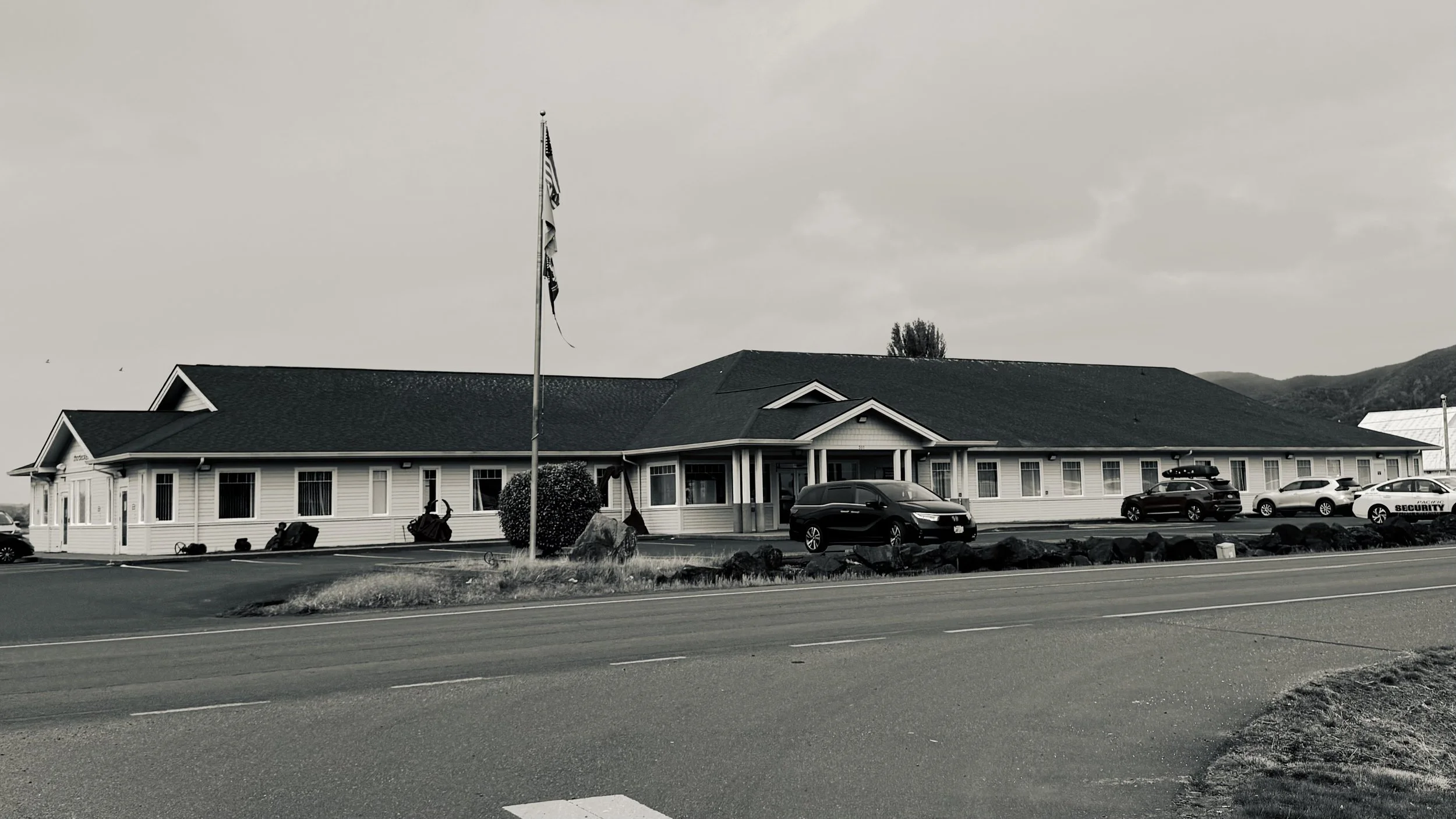
Pictured is the building at 307 Robert Bush Drive East in South Bend, Washington that Pacific County purchased on May 13, 2025, in a $2.5 million deal.
SOUTH BEND, Wash. — Tensions boiled over at the Pacific County Board of Commissioners meeting on Oct. 13, 2026, where former District 3 commissioner candidate Ron Mullins publicly demanded the resignation of all three commissioners.
At the heart of the uproar are high-stakes real estate transactions, led most notably by a multi-million-dollar off-market building acquisition that bypassed what is considered "traditional due diligence."
The controversy highlights a deepening chasm between local government decision-making and public trust, throwing a spotlight on how public funds are spent, how assets are valued, and why closed-door governance continues to trigger fierce community blowback, even when officials feel they are doing what is in the public's best interest.
Millions Spent, No Appraisal
The primary focal point of public frustration is the county's acquisition of the now-former Harbor Rock, Inc. property at 307 Robert Bush Drive East (Parcel #14092733040) in South Bend, which currently houses Thorbeckes and a branch of the Washington State Department of Social and Health Services (or Department of Children, Youth, and Families).
The Pacific County Commission voted unanimously on May 13, 2025, to purchase the 10,000+ square foot commercial building for $2,500,000. The transaction was structured with a $500,000 down payment due at closing, followed by annual installments of $500,000 carrying 4% interest through May 1, 2029.
Public records show the property was valued by the county assessor’s office at $1,377,800—leaving an 81% gap between the tax roll baseline and the final purchase price.
Unlike typical commercial transactions where properties are openly listed and put through competitive bidding, this property was off-market. The former owners approached the county directly to pitch the sale.
The County’s Defense: Bypassing Appraisals Out of Fear
When pressed on why the county agreed to pay $2.5 million without a traditional independent commercial appraisal, Pacific County General Administration Chief Administrative Officer Paul Plakinger confirmed a striking reality to Veritas Coastal - no appraisal was ever conducted.
According to Plakinger, the administration deliberately avoided getting an independent appraisal because they were concerned it could have driven the value of the building "through the roof." Instead, the county relied internally on a cost-avoidance and revenue-retention model.
County officials reasoned that building a comparable facility from scratch would have cost between $3.5 million and $5.5 million, making the $2,500,000 price tag look like a relative bargain.
Commissioner Jerry Doyle, a seasoned contractor, ran some complex math which included evaluating what a new built-from-scratch building would cost, and then evaluated the deal through a per-square-foot analysis and concluded $2.5 million was a really good deal.
Additionally, by acquiring the property, the county locked in roughly $17,000 per month in ongoing lease revenue from state agencies (such as DSHS / DCYF) that were already renting space in the building.
While this internal calculus makes pragmatic sense on a spreadsheet, skipping an independent appraisal in an off-market negotiation initiated by the seller turns standard due diligence on its head. Critics argue that fearing an appraisal would raise the price makes little sense when there are no competing buyers. Operating almost entirely behind closed doors—with initial public records requests blocked by "deliberative process" exemptions—created an information vacuum that left taxpayers rightfully suspicious.
Opportunity Cost — Essential Infrastructure Stalled
The blowback over the $2.5 million price tag was severely amplified by concurrent disclosures regarding the county's budget. Just weeks after the purchase became public, officials revealed that a long-planned remodel of the Pacific County Courthouse and Public Safety Building had stalled out.
That project—designed to fix severe security bottlenecks highlighted by a failed security audit and resolve ADA non-compliance issues in courthouse restrooms—was left with zero local discretionary funds.
County administration disclosed that flexible reserves, including over $3.7 million in unspent American Rescue Plan Act (ARPA) funds, had been entirely exhausted on public safety salaries, benefits, and new patrol vehicles. For local residents, watching millions flow into an off-market commercial building while core public safety infrastructure languished created a potent political flashpoint.
Intersecting Land Deals — The Shoalwater Bay and Lodestone Connection
Adding fuel to the fire is a second transaction finalized on December 30, 2025: the sale of 18.33 acres of county-owned unimproved land (Tax Parcel No. 14110424200) to the Shoalwater Bay Indian Tribe for $400,000.
The deal was explicitly structured around the assignment of an existing 10-year commercial lease the county had established with Lodestone Quarry in August 2024. Critics like Mullins have questioned the mechanics and long-term financial return of these interlocking property and lease handoffs, pointing to them as examples of mismanaged public assets.
The Push for Accountability
During public comment periods, Mullins—who campaigned heavily on government accountability and the removal of all current commissioners—brought these grievances directly to the dais, translating a complex web of unorthodox real estate deals into a populist call for leadership turnover.
While local governments possess broad statutory authority to buy and sell real estate, the core friction in Pacific County remains a lesson in political optics. When millions in public funds are committed without competitive bidding, without independent appraisals, and behind tightly guarded administrative exemptions, the public will inevitably demand answers.
October Surprise - The Politics of Timing
The friction over the county’s real estate dealings has also reignited at an unmistakable timing, as general election ballots are beginning to arrive at mail boxes. Coming forward with fiery public testimony at such an unmistakable time highlights a classic local political playbook.
From the perspective of critics and challengers like Mullins, utilizing public comment periods to put maximum pressure on incumbents when the electorate is actively paying attention is a core form of civic accountability. For the administration and its supporters, however, these synchronized public outbursts are viewed as calculated political theater designed to maximize friction and sway undecided voters when it hurts the most.
Whether viewed as populist oversight or election-season staging, the convergence of a multi-million-dollar property acquisition, missing appraisals, and the ballot box has turned routine local governance into a high-stakes referendum on leadership.